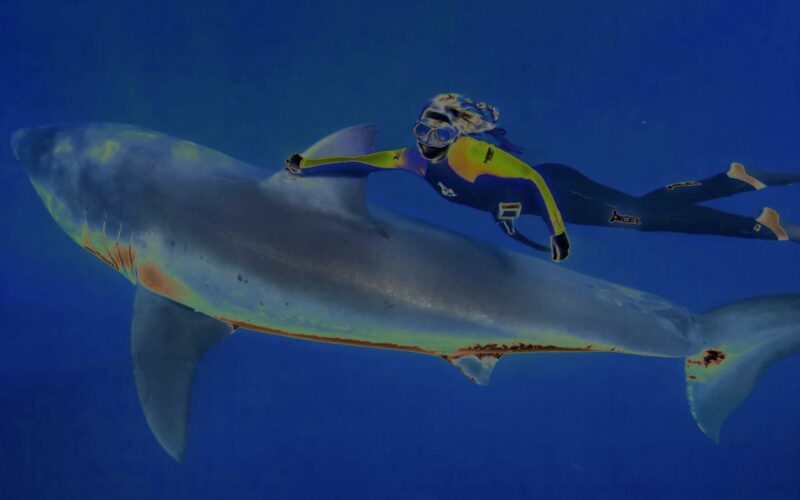
With “Jaws” as its spearhead, pop culture has appropriated the shark issue and magnified an unfortunately rather negative image which, although receding, harms their conservation — following the adage that we think, consciously or not, that “a dead shark is one less danger in the ocean”… Within this pop culture, humor has played and continues to play an essential role in transmitting these credos.
My latest study (1) looked at these subliminally transmitted messages and confirmed, as an example, the privileged place of the “Mistaken Identity Hypothesis” (MIH), whose ineptitude and pernicious effects we demonstrated in a study published in 2023 (2). The shark does not make a mistake when it involuntarily bites a surfer, supposedly confusing it with natural prey — it is simply engaged in a deliberate exploration of an unfamiliar potential prey. Yet no fewer than 30% of humorous cartoons rely on the MIH.
We should therefore adjust our aim — obviously keeping humor as an eminently precious propaganda tool, but changing the substance of the messages and ridiculing the human rather than the shark…
References of the scientific articles mentioned in the text
(1) Clua EG Eric (2026). Humor as a leverage in shark pop culture: keep the tool but change the message. American Journal of Humanities and Social Sciences. Volume 16, issue 1. Pp. 05-11. Read the article
(2) 2023 study on the mistaken identity hypothesis (HAL — University of Perpignan, in French)