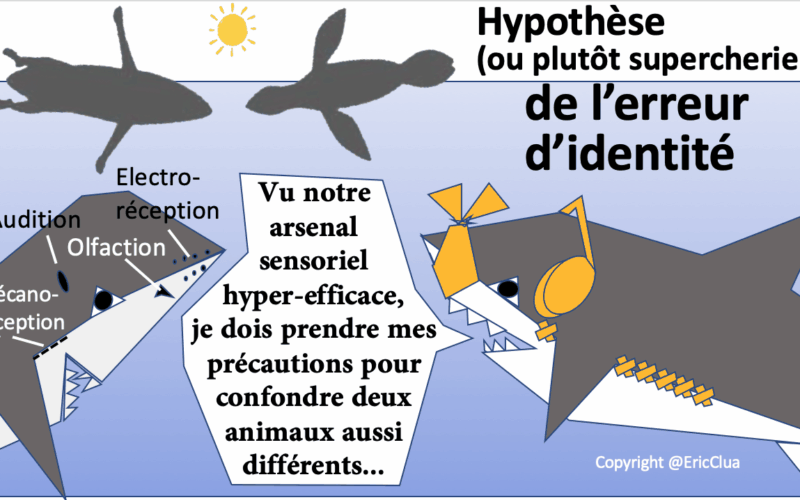
It is commonly accepted that populations of large terrestrial predators (such as bears or tigers) include “problem individuals” that repeatedly go after humans for predatory purposes. Yet this phenomenon, which remained a mere hypothesis — published in 2018 in Conservation Letters — had never been demonstrated for aquatic predators such as sharks.
In our latest study, also published in Conservation Letters, we describe three case studies from three different oceans (Pacific, Caribbean Sea and Red Sea), involving two species dangerous to humans, the tiger shark and the oceanic whitetip, and relying on two different methods (photo-identification and genetic analysis): one and the same shark killed a first person before going after other humans, also considered as prey.
These case studies constitute the first irrefutable evidence that certain (rare) individuals among large sharks are capable of repeating aggressions on humans.
The percentage of such individuals is unknown, but this study calls for systematizing DNA collection (by swabbing, carried out by medical staff) on human victims of shark bites in order to better understand this phenomenon. This approach would make it possible to implement shark risk management strategies focused on the strict removal of animals proven (through genetic matching) to have already bitten, and which have a higher probability than their congeners of going after humans again. It also argues for banning the indiscriminate culls currently used by the authorities, which are not only ineffective but also harmful to the environment and ethically questionable, since they target animals that pose no risk to humans.
Clua, E.E.G., Carl G. Meyer, Freeman M., Baksay S., Bidenbach H., Haguenauer A., Linnell J.D.C., Séguigne C., Surina S., Vely M., Vignaud T., Planes S. (2024). First evidence of individual sharks repeatedly targeting humans. Conservation Letters; 0:e13067. Pp. 1-8.