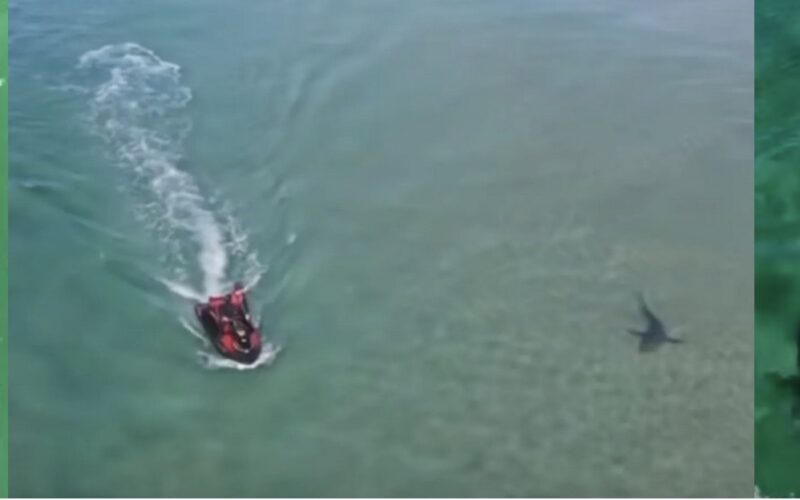
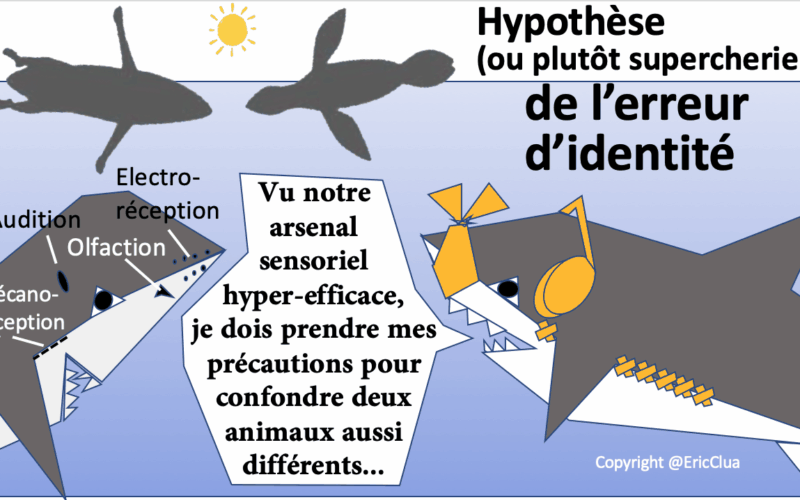
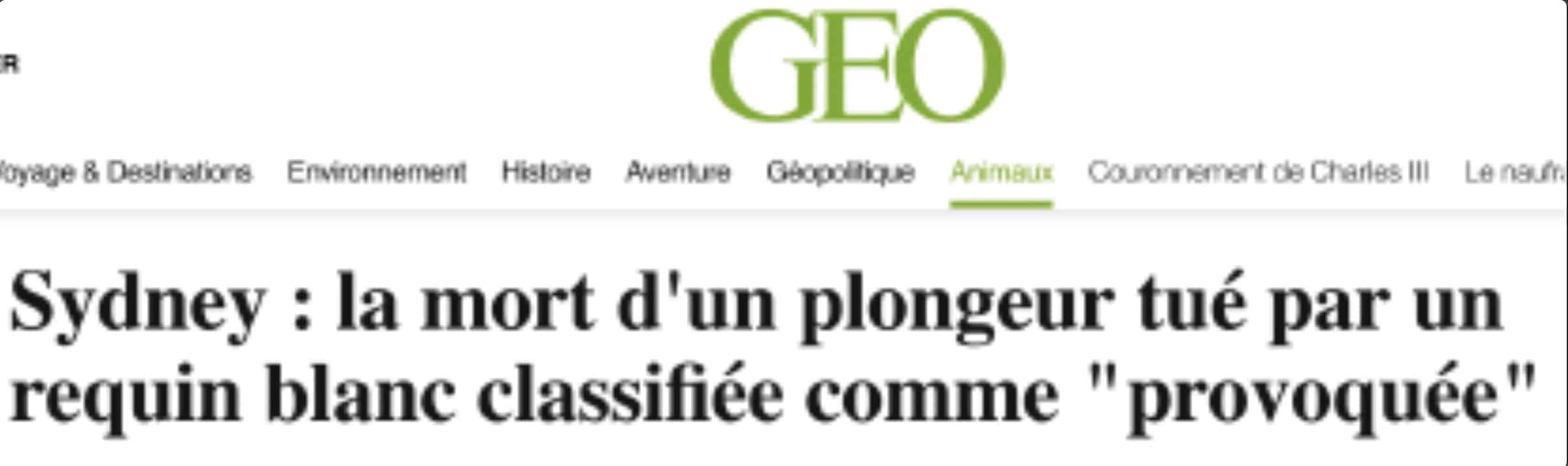
We have just published an article (1) describing the motivation of “self-defense” or “retaliation” in sharks, invoking an adaptation of the Talion law — “tooth for a tooth”. Nothing seems more legitimate for a shark than to defend itself when a human assaults it, sometimes with intent to kill, as fishing implies. Nevertheless — and this is more subtle — a shark may bite a human who is trying to rescue it, notably when it is stranded on a beach. One must understand that the shark has no notion of the benevolence extended to it, and its first reflex, under violent stress, will be to bite its would-be rescuer.
The problem is that, whatever the motivation, benevolent or malevolent, a shark bite will most often be treated by the media as an “attack”, casting discredit on the animal when the main responsibility lies with humans — something those same media rarely mention, locking sharks into this role of bloodthirsty aggressors.
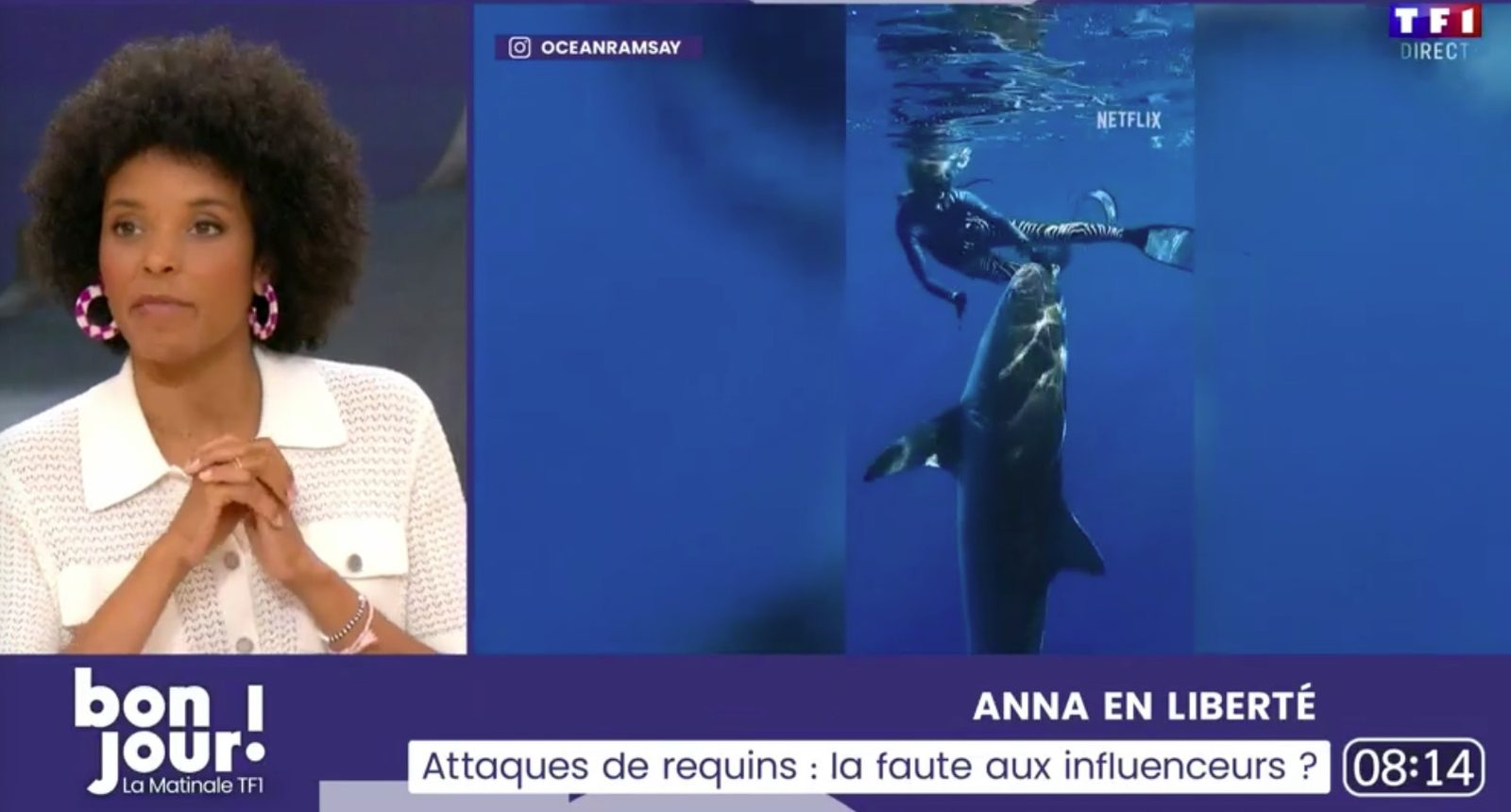
Our article confines itself to these considerations, but journalists have asked me about the behavior of influencers who, as freedivers, cling to sharks or even handle them. The avowed goal is “to show how harmless they are” or “to remove hooks deemed harmful to their physical health”. First, as our 2017 study (2) on a tiger shark population in French Polynesia demonstrates, hooks are very well tolerated by sharks (a kind of harmless piercing).
Second: NO, sharks are not harmless — they remain potentially dangerous predators, even if bites remain an extremely rare event.
It is therefore irresponsible to suggest to millions of swimmers and freedivers that they should so much as touch a shark. It is also, in my view, an unbearable lack of respect for these animals. And everything suggests that these influencer behaviors stem above all from poorly managed narcissism and from an instrumentalization of these animals for commercial purposes. Having attractive looks and freediving abilities undeniably above average should not lead to such deviant practices, ultimately harmful to the very animals whose conservation they claim to promote.
References of the scientific articles mentioned in the text
(1) Clua, E. E., Vignaud, T., & Wirsing, A. J. (2025). The Talion law “tooth for a tooth”: self-defense as a motivation for shark bites on human aggressors. Frontiers in Conservation Science, 6, 1562502. Read the article
(2) Prevalence, persistence and impacts of residual fishing hooks on tiger sharks
(3) TF1 news, July 16, 2025: “Attaques de requins : la faute aux influenceurs ?” — La Matinale TF1 (in French)